Thursday, November 15, 2018

Thoughts of Rodin


Thoughts of Rodin


Tracy Bowens
November 15, 2018
Paper 1 – Thoughts of Rodin


  I mentioned in my Yale Art Galley post that I was an admirer of the French sculptor Auguste Rodin, and the professor, rightly so, admonished me for not having delved deeper into the artist or the particular work I had gone to see, the Thinker. Here I will endeavor to rectify those omissions. I have sculpted for almost ten years, after many years of admiring the works of great artists like Michelangelo, Donatello, Henry Moore, Alberto Giacometti, and am currently an admirer of Jamaican sculptor, Basil Watson. As wonderfully talented as these artists were/are, my biggest inspiration has always been Auguste Rodin.


August Rodin photographed in his studio by Paul François Arnold Cardon a.k.a. Dornac (1858–1941).

Photo and caption form https://en.wikipedia.org/wiki/Auguste_Rodin


  By the time of his death in 1917, Rodin was the most famous sculptor of his time and was, unlike many great artists, a wealthy man, as he well sought after by rich patrons for commissions. Not only did they wealthy seek him out but so too did the famous. In fact, despite having many signature and renowned works, it was his portrait bust of French writer Victor Hugo, that had fascinated me most. From afar I had often gazed at pictures of the portrait wondering how someone could create so life-like resemblance out of bronze. I didn’t know at the time that he worked in clay and that the bronzing came later, remember this was a long, long time ago, I didn’t know any better. The bust appeared more akin to a portrait of Zeus than that of an aging writer.


  In 2012, I visited Paris and was fortunate enough to see several of the master’s works up close, including another bust he had done of Hugo that was housed at the cavernous Musée d'Orsay. The museum was a former railway station that display some of the most well-known artist of the late nineteenth century, including others works by Rodin. Here is a picture of the second Hugo bust. This Hugo, head tilted downward, is introspective than the previous forward gazing, paternal visage of the former. Both portraits exhibit the humanistic realism that Rodin was known for. Unlike many of his illustrious predecessors, who smooth and perfect figures sought divine comparisons to the mythological gods, Rodin’s figures gave witness to man’s imperfections. Every crease, every wrinkle, are put on full display, as if, as some of his detractors would rumor, human beings were encased in plaster


Photo from Auguste RodinVictor Hugoen 1897buste en bronze et fonte sur piédoucheH. 70,6 ; L. 61,5 ; P. 56,8 autre dimension H. 20 ; L. 26 ; P. 26 cm (piédouche)musée d'Orsay, Paris, France©photo musée d'Orsay / rmn


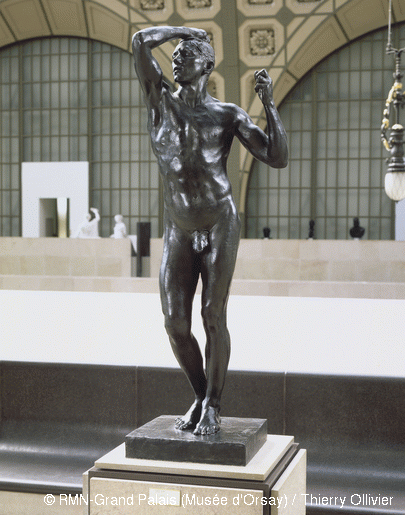
  Other works of Rodin within the d’Orsay include, The Bronze Age, which is more reminiscent of a Donatello or Michelangelo sculpture, which may have been intentional as a way of silencing his critics. 


Photo from https://theartstack.com/artist/auguste-rodin/the-age-of-bronze

  The life-sized nude male is more classical that some of his other works.  
  Among those other works would be the aforementioned Thinker, and the equally as famous, The Burghers of Calais. The Burghers were another commissioned piece, but uncharacteristically, one he had to compete for when the town of Calais wanted to memorialize an event from the Hundred Year’s War. Rodin won the commission and created the life-sized grouping of six anguished looking robed men appearing to burden with pain and doubt. According to Wikipedia there are only twelve, the maximum allowed under French law, original casts created.  One of which is at the Metropolitan Museum of Art in New York. I look forward to seeing that soon. Pictured is the one in Paris at the  Musée Rodin.

Photo from Les Bourgeois de Calais par Auguste Rodin au Musée Rodin de Paris

  I'd be remiss if I failed to mention the work of another that was closely tied to Rodin, and that is his one-time student, assistant, collaborator, and lover, Camille Claudel. A talented artist in her own right, she suffered emotionally, financially, and eventually mentally after the break up with Rodin who refused to take her as his wife. The autobiographical piece she created, The Mature Age, is part of the d’Orsay collection and illustrates the end of their association.


Photo from The Mature Age L'age mûr, statue de Camille Claudel, Musée d'Orsay, Paris


Of all the works of Rodin, one stands above all others in terms of ambition, scope, and creativity. I was struck by the sheer size of the giant doorway which is nineteen feet in height and thirteen feet wide. It is enormous to say the least. Rodin was commissioned to create the project within five years, he worked on it for thirty-seven years, stopping only due to his death. He was inspired by Dante’s, Divine Comedy. The Gates are adorned by many miniature replicas of his other works that would be enlarged to be individual works on their own, the most well known being the Thinker, which represented Dante, overlooking the top of the doors entrance. The one displayed at Musée d'Orsay is said to be the original plaster that Rodin worked on, the others around the world were cast from this original.


Photo from Gates of Hell Musée d'Orsay Picture taken by deror avi on June 2005. {{Attribution|1=deror_avi}} Category:Gates of Hell Category:Musée d'Orsay


For size context, below is a version with admirers in the foreground.

Photo from https://www.artble.com/artists/auguste_rodin/sculpture/the_gates_of_hell

Here the Gates are flanked by representations of Adam and Eve, located at Stanford University.

Photo from https://upload.wikimedia.org/wikipedia/commons/1/13/Gates_of_Hell_sculpture_by_Rodin_surrounded_by_Adam_and_Eve.JPG

For all the images within the Gates of Hell, roughly around one hundred eighty figures, two original figures are absent from the final display. Paolo and Francesca, the lovers locked in eternal embrace displayed in, arguably, Rodin’s most recognized sculpture, The Kiss, had been removed from The Gates.
Photo from http://www.anngeo.com/rodin/kiss.html
  The Kiss was inspired by the tale of a noblewoman who fell in love wit her husband’s brother and was killed by her husband for the transgression. Rodin didn’t feel that the lover’s happiness meshed well with the misery that The Gates represented and removed the piece. The characters are represented singularly on The Gates away from each other’s tender arms. Rodin, it seems, may have been a bit of a romantic, although Camille Claudel might disagree.

Cites
 http://www.musee-rodin.fr/en/collections/sculptures/victor-hugo-known-bust-illustrious-master


https://en.wikipedia.org/wiki/Auguste_Rodin
https://theartstack.com/artist/auguste-rodin/the-age-of-bronze
http://www.anngeo.com/rodin/kiss.html

Tuesday, November 13, 2018

Metropolitan Museum of Art Intro

Hello All,

I made my way to New York City this weekend and connected with my sister who took the train from Long Island to come check out the Metropolitan Museum of Art. I have my discussion pieces for my paper, but I wanted to share some of the things that I chose not to include, because I still thought them to be interesting. They're from the various areas we visited (we didn't see the entire museum; I only had a four hour window to work with, but we did get to Egyptian, Medieval, Asian, and European art). Think of this as one of those appetizer sampler plates you can order at Chili's!


First up is a very elaborate mummy mask that we saw on display in the Egyptian section on the first floor. The front of the funerary mask is super elaborate, facial detail was very well done, and the texture of the hair kept me examining the piece for quite awhile. It is composed of plaster, cartonnage (research tells me this is linen mixed with more plaster) and paint. where the piece gets interesting for me is the preservation of the sides and the back, which depict your expected scenery of Egyptian gods.

I was amazed at the preservation of the color, still so vibrant! I was awestruck at the still intact artwork all around the headpiece. The placard adjacent to the display tells us that the scarab wreath, "represents the sun appearing at dawn, a metaphor for rebirth," and that, "The lower register centers on the god Osiris, the source of regenerative power, who is flanked by Isis and Nephthys." Nephthys is sister to Osiris and commonly depicted as protector of mummies.


Account Book Cover. 1343 AD
Next up is something I never expected to see in a museum. What you are looking at is a very old, very early, account book. The placard explains, "Book of the Income and Expenses of the Biccherna of the Commune of Siena from the First of July to the First of January 1343." The cover shows the owners of the book engaged in accounting for the funds of whomever they were responsible for. I was excited to see this for a few reasons. As I mentioned previously in my Yale Art Gallery posting (which you should read if you haven't yet) that Siena was a very famous region of Italy during the early Renaissance. The second reason I was excited was because of the date. 1343 AD is almost 100 years before the birth of Luca Pacioli, the father of the double entry book keeping system for accounting (sorry, I'm an accounting major and nerdy things excite me sometimes!), so I couldn't help but wonder what the hell early book keeping systems looked like prior to the implementation of our modern system? What else intrigued me was the fact that the book binding was composed of wood, namely because you wouldn't get reuse out of something like this at this point in history.


From the European art section of the museum, I also got an up close look at an incredibly famous painting, that anyone who has enrolled in humanities courses at Albertus should recognize easily.
The Death of Socrates. Jacque Louis David
1787. Oil on Canvas 
 Jacque Louis David's rendition of The Death of Socrates is fairly well-known. I can count at least three liberal arts and humanities courses I have taken at Albertus that have brought this painting up when discussing Apology. I never imagined I'd get a change to see it up close!
If you're unfamiliar with the story of Socrates, in his lifetime as a Greek philosopher, he sought to seek out those wiser than he, as the Oracle at Delphi prophesied there was none wiser than he. Because of his dialogues, he was labelled a threat to the Greek state and put on trial for alleged corruption of Athenian youth. He is sentenced to death by ingestion of hemlock, which he willingly undertakes.

This is where the painting picks up. Socrates is ready to meet his fate, defiant, as evident by his stern facial expression, and finger pointing. There is much symbolism involved in the painting, the shackles heaped to the floor, the light shining through the prison cell, illuminating Socrates symbolizing his enlightenment and freedom in death. His followers all around him mourn his loss as he tries to tell them that this is for the best. As I've said, I've seen the painting so many times in the past but never up close. There was one detail I noticed this time that I never saw.


There are individuals leaving the prison cell in the background, waving farewell. They are clearly mourning, but yet they still leave Socrates in his hour of triumph.

The last piece I chose to share but not include in my final paper was from the Asian art section. The wing of the museum over here is broken up into the different regions of Eastern and Southeast Asia. To tell you that there is a very large amount of Buddha statues on display is an understatement. We must have spent probably an hour just looking at various statues of Buddha and various Hindi gods and goddesses. There was plenty more to see in terms of actual art as well, but the statues are really worth viewing, as you can see half a dozen statues of a single deity and no two are alike.


11th Century Representation of Buddha
Delivering his First Sermon.
I think this one is the best chosen to discuss. This is an 11th century representation of the Buddha preaching his first sermon at Sarnath after reaching enlightenment. I did research Buddhism for a period, not as a religion, but because it was something that you don't see regularly in American culture, despite being such a large religion, so I am somewhat familiar with the reason for the composition of the statue. If you are unfamiliar with Buddhist theology, Gautama Buddha was a monk, who, unsatisfied with the ascetic life of a monk in ancient India, sat beneath the Bodhi tree and vowed to not move until he attained enlightenment. Forty-nine days passed before he reached this state. Sarnath was where he gave his first sermon on the Dharma.

So since this is primarily a religious artifact, there is very distinct symbolism in what he is doing. Buddha's seated position is the lotus position and in meditation, it encourages proper breathing and is representative of physical stability. The hand position is representative of turning the Dharmachakra (cycle of change) wheel in motion, something he accomplished in his first sermon. One of the things I wondered as I looked at most of these statues (and have yet to research) was why in the majority of representations there is what appears to be a floral design in the palm of the hand?

So there you have it. This is a small example of where we had wandered through the museum and what we had seen. There was quite a bit left unseen also. In the American wing, there is a floor that is just period rooms from the 17th century to present day. I desperately wanted to go see this, but the two of us were so exhausted at that point. There was also the whole section of contemporary art and Greek and Middle Eastern Art that I have yet to see. I have two distinct and comparable pieces for my paper that I'm excited to discuss and plenty more to write about from visiting the museum by the end of the week.

Yale Univ Art Gallery Paper

Kiya Clark
November 12, 2018
Paper 1 – Yale University Art Galley
Simplistic
I visited the Yale University Art Gallery on Thursday Afternoon after work. I was initially going to pick up my kids from daycare and school, but decided to use my “free hour” after work to visit alone. I’ve been to the museum before, a few times as I mentioned in my weekly post. There was no big awe or excitement by the entrance of the museum, except I adored the simplicity of it. The security and front desk staff were helpful and friendly, that’s normal for the museum and I always appreciate their suggestions. I told the front security guard (because they’re at the museum all day every day I usually rely on their suggestions) that I loved simplicity so he recommended going to look at some of the modern art pieces.
            After doing some research on the museum itself, I was surprised to find out how long it has been around. It was founded in the year 1832, making it one of the oldest museums. The museum has seen its fair share of renovations over a great span of years. In 1953 the museum was designed by, a then professor at the school, Louis Khan. The gallery was then under construction for 14 years for a huge, 135 million dollar renovation to return much of the design to originally intent Khan had, and reopened in 2012. The museum is free and open to the public, with a number of programs for the university as well the surrounding community.
I quickly browsed through the first floor, not paying much attention to the pieces. It was rather crowded and at least 3 guided tours (or schools) were beginning on the floor so I chose to go where the security guard suggested. I knew right away that I was entering the “Modern Art” section of the museum. The design of the floor was open, simple, and clean. I loved it, and started to slowly walk through the floor looking for a picture or sculpture to catch my eye. The openness of the floor was a strength because it almost forces patrons to slow down and appreciate each piece or art because they are spread apart throughout the floor. It takes time to get from one artist’s work to another.

           
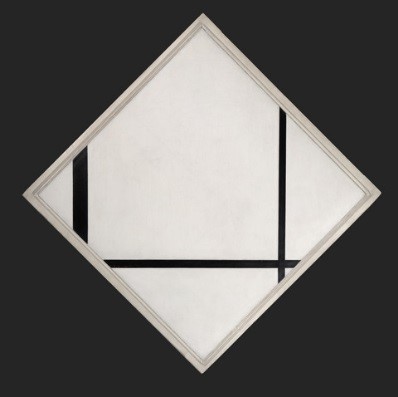
           The art that caught my eye right away was done by Piet Mondrian, formerly known as Pieter Cornelis Mondriaan. The three pieces are done with oil on canvas. There are three small pieces somewhat grouped together so I analyzed them as a whole. The pieces were created in 1929 and 1930. The art doesn’t have much color, but very pronounced lines which help with the minimalist vibe I picked up while sitting on the bench in front of the pieces.
The clean lines and defined, yet small amounts of color I think signified the beauty or necessity in doing or being minimal. His work eventually held a spiritual importance, I think this is evident in the lines being balanced and connected. Although the lines aren’t identical they each (touch) rely on each other to create a complete picture. Below is the center photo, alone it is simple, almost too simple nothing more than shapes and lines. But partnered with the two pieces next to it I think the religious connections Mondrian sought to portray are evident.


“Mondrian took an interest in impressionist techniques and this form of art with the early works that he did. Like Van Gogh, Mondrian use pure, glowing colors and expressive brushwork under the influence of pointillism and Fauvism.” Piet Mondrian and his paintings. (2011) Piet started out with Van Gogh style of painting and ultimately his style became more abstract. His later work was what he was most known for, his use of minimal color and ultimately reimagining what was considered art. Specifically after returning home to Holland, his work started to evolve. Rather than some of the still life painting he previously participated in creating, “he developed work which delved in to the spiritual realm, and created more of a connection with religion, and his faith, as opposed to the prior works which were not focused on this point.” Piet Mondrian and his paintings. (2011)  His work would be considered part of the abstract movement of art in the beginning of the 20th century. Piet was one of the founding members of the Dutch modern movement “De Stijl”. This movement was all about simplifying art and paintings to the simplest of elements, like nature. His work relied mostly on vertical or horizontal lines.

References
Piet Mondrian and his paintings. (2011). Retrieved November 12, 2018, from https://www.piet-mondrian.org/
Yale University Art Gallery |. (2018, November 09). Retrieved November 12, 2018, from https://artgallery.yale.edu/

Monday, November 12, 2018

Wadsworth Atheneum Museum of Art


My first trip to the Wadsworth Atheneum Museum of Art left me not only impressed with the impressive collection of at held within it’s wall, but with its history. The museum, which first opened its doors in 1844, is the oldest in the country. The collection includes antiquities for Egypt, Greece, and Rome, modernist paintings, and European art. The building, itself can considered a piece of art, looks like a castle.


The first exhibit I stumbled upon, by total chance, was in the Amistad Room, which housed an exhibit called Words, Pictures and Music. The exhibit showcased primarily historical photographs the highlighted the connections between art and social struggles. Throughout the room were quotes from Langston Hughes, Frederick Douglass, Paul Lawrence Dunbar, and Gwendolyn Brooks among others.


  There was this painting by Elbridge Ayer Burbank of a young black boy smelling a rose entitled American Beauty, 1906. Burbank primarily painted Native Americans as he was sympathetic to there plight, however his earliest subject for portraiture were Black children. The title, American Beauty, one can imagine as being quite controversial at the time.


     The next photograph was by an unknown photographer of depicting the Reverend Benjamin W. Arnett in his early years. Arnett was a civil rights activist during the 1860s and would go on to become an elected official for the Ohio General Assembly where he was instrumental in changing laws that provided equal educational opportunities for black children. He also became friends with fellow legislator and future president, William McKinley.


   Another rare photograph showed a young Paul Robeson playing during his football career at Rutgers University in 1919. The name of the photographer is unknown. Robeson was multi-faceted as he was a college football All-American, a lawyer, an actor, an opera singer, and a social activist. The photo shows the early determination that would come to signify the struggles, and the resolve, that Robeson would face in the future.


  I walked the museum after leaving the Amistad Room and came upon the Surrealism exhibit called Surrealism and War in the 1930s and 1940s. Unfortunately, photography was not allowed on this floor, therefore works by Andre Breton and others went un-captured.


The below piece is entitled Apparition of Face and Fruit Dish on a Beach by Spanish painter Salvador Dali. The painting is true to the Dali’s style of creating optical illusions with hidden meaning. At the center of this picture is a bowl in which a face can clearly be seen. This face was a tribute to his friend, poet Federico Garcia Lorca, who had been murdered by Nationalists near the start of the Spanish Civil War. Lorca is meant to be the apparition that the title refers to, and was placed there as a form of protest.


Image courtesy of Google images


Another Dali painting, Soft Construction with Boiled Beans, was also present and too alluded to the troubles of the Spanish Civil War. This painting, created six months before the start of the war was prophetic and depicted imagery of two monstrosities that have emerged from one singular creature and are in conflict with each other. This clearly represents Spain and the two sides which will soon come into conflict and inflict much horror upon itself, and thus his beloved homeland.


 Image courtesy of Google images


There was much more Surrealist artist represented, the no photo rule really stymied me. Among the others who’s works protested the war were Picasso, Blumenfeld, Breton, Miro, Ernst, and myriad others

What is the connection between paintings of the Spanish Civil War era and photographs depict African American history? Artists have often had the tendency to use their art to speak out against injustices and to inspire outrage at situations. The photographs, along with the accompanying information cards, celebrates the struggles and triumphs of African Americans during the late nineteenth century and the early twentieth century. The paintings of the Surrealists were using their art as a protest against war. Like renowned photographer Gordon Parks, who considered his camera to be his weapon, so too do other artist you their respective forms as weapons against war, bigotry, oppression, and injustice. Few groups have been a keenly aware of this as were the Surrealists and the Black artists documenting a changing nation.

Sunday, November 11, 2018

Yale University Art Gallery Paper

Hello All,

Below is my paper for my Yale University Art Gallery visit. I hope you enjoy it as much as I did with the visit. Professor, I will be sending you a file copy in case you would like to review in Word for length, etc. I had to recreate all the photos and their positioning in Blogger because it does not allow for transition without uploading photos.
Yale University Art Gallery Visit

Sean Rallis

                I had chosen to deviate from my anticipated schedule and pre-empt my first museum visit to the Metropolitan Museum of Art with a trip to the Yale University Art Gallery. This proved highly beneficial, as I was able to offset each week’s visit with posting for the previous week’s visit. At the request of my wife, I took her and our children with me on my visit (they will be my traveling companions for every week except for the visit to the Met, to which my sister took the train from Long Island to come visit). We made our way over to downtown New Haven on November 3rd in the early afternoon.

Yale University Art Gallery Exierior
For a weekend day, I didn’t find the museum as crowded as I had anticipated. There were more people traveling the streets outside of the museum than were found inside; mostly college-aged. Both times I have visited the museum (once on a weekend and once in the middle of the week) I have found this to be the case.

Yale University Art Gallery is the oldest university art gallery in the Western hemisphere. It was originally built in 1853 after John Trumbull (most noted for his Revolutionary War paintings) had donated a collection to the college. This building was on the old campus grounds and was demolished. The interesting thing that I saw while I was there (and I regret not getting a photo) was that John Trumbull and his wife are buried on the grounds below the first-floor antiquity gallery. The newer building was constructed in two phases: the first phase was completed in 1928 by architect Edgerton Swartwout. The second portion was completed in 1953 by Louis I. Khan. Visitors will notice two distinct styles when wandering the interior as a result of this. According to Yale’s website, Edgerton designed his portion as an, “older “Tuscan Romanesque” section of the gallery…distinguished by the neo-Gothic arched windows and Art Deco bridge over High Street.” (buildings.yale.edu). The archways and stairwells reminded me of Yale Peabody Museum.

                I find the museum quite easy to navigate. The elevators inside each have a map of the building. There are three "towers" inside, each connected by a walkway across the multiple floors. My first time that I visited the art gallery I was there to focus on the European Art, specifically the Renaissance and early church art. I was able to see more of the museum this time around, but not much more, because there is only so much attention that toddlers can give to wandering a museum before they hit a wall. We were able to revisit the European Art section, which I was fully able to wander this time around, and we took a trip over to the American paintings and sculptures section.

                I enjoy the way that the European Art section has this sort of division to the presentation. The portion of the gallery that contains much of the Byzantine, Renaissance and early medieval art has a much more reverent atmosphere. There is no natural lighting because this is a more interior-portioned gallery. As a result, I think it enhances the viewing; it gives me the impression as I walk among the portraits, icons and statues that I am not in an art gallery but wandering the hallways of some old, historic church. Once you make your way into the remainder of the European gallery, it becomes an art gallery in the more traditional sense. There is more natural light filtering in as you make your way past works by artists such as Monet, van Gogh and Peter Paul Rubens.

                I found American paintings and sculptures section to be a vastly different and less intimate experience than the European gallery. Many of the works in this hall are on a much larger scale, portraits that scale floor to ceiling, grand landscapes that encompass entire walls, and the like. Just for frame of reference, the below painting is almost 9 feet long by 4.5 feet tall, massive! The hall itself sports very cavernous ceilings. I enjoyed the actual rooms as well. The choice of colors, flooring, and wood trim and molding, along with the paintings gave me a similar impression to that of the previous gallery in that while viewing these paintings I felt like I was walking the halls of a historic home.


Richard, Duke of Gloucester, and the Lady Anne. Edwin Austin Abbey. 1896.Oil on canvas
                Rather than focus on one specific piece that caught my attention, I wanted to discuss a specific subject that I found among three of the pieces. On my first visit to the art gallery earlier this year, I was intrigued by a pair of paintings from the early Italian Renaissance works that told a story from the life of Saint Anthony the Great. I am not a religious person, and I am quite unfamiliar with much of the legends and myths surrounding the lived of Catholic saints, but I’ve always been fascinated with religious art. I love that so many people over the course of history have taken to so many different interpretations of the same stories in different styles. The first image shown is called The Temptation of Saint Anthony Abbot. This work was painted by an individual known as Master of the Osservanza. The artist is relatively anonymous, though it is speculated he was really Sano di Pietro, another Sienese artist, whose contribution to the gallery I will discuss briefly later. According to information taken from the J. Paul Getty Museum website, Scholars named him for a triptych in a church just outside of Siena. The Church of the Osservanza, which is Italian for observance…”(getty.edu) Siena was also a very well-known region for the arts during the Renaissance. 


The Temptation of Saint Anthony Abbot.

Master of the Osservanza. 1435-1440. Tempera on panel
As a brief overview of the subject, Saint Anthony the Great was one of the first monastic priests in the Church. He was born in 251 AD in Egypt. After the death of his parents, he sold his inheritance and began living a life of asceticism. According to the Orthodox Church of America, In this period of his life Saint Anthony endured terrible temptations from the devil. The Enemy of the race of man troubled the young ascetic with thoughts of his former life, doubts about his chosen path, concern for his sister, and he tempted Anthony with lewd thoughts and carnal feelings. But the saint extinguished that fire by meditating on Christ and by thinking of eternal punishment, thereby overcoming the devil.” (oca.org) It is in this painting that we see this temptation on display.

Close up of the tempting devil
Close up of Saint Anthony
One of the more interesting things I noticed about this painting was the strange composition of the landscape. There really isn’t a level frame of reference in the painting, but what I found strange was the curvature of the sky and the distant landscape as opposed to the foreground where the subjects stand. It comes off as a strange combination, almost as if I am viewing the painting partially through an apartment door peep hole. My focus was also drawn to the peculiar proportions of Saint Anthony. I can’t help but notice how far down his knees appear to be in his frame, hand outstretched in resistance.
The tempting devil in this painting takes on a form of a woman to turn Saint Anthony aside from his resolute life of religious, monastic solitude and return him to his former life. I am unsure if I interpret her folded arms as a sign that she is not phased by his resistance or if this her hands folded inward, a sign of her false innocence behind her motives?

Further into the European gallery, amongst the Dutch painters sits two paintings that pertain to the same story. Each is unique in representation of the temptation. The first painting is by Jan Brueghel the Elder, painted in 1594. This, too, is entitled The Temptation of Saint Anthony.


The Temptation of Saint Anthony. Jan Brueghel the Elder. 1594. Oil on copper.
                Jan Brueghel the Elder was born in 1568 in Brussels, Belgium. He was part of the Flemish Renaissance movement. The Flemish Renaissance was brought about in response to the Italian Renaissance and as we are told via Wikipedia, Dutch and Flemish painters were also instrumental in establishing new subjects such as landscape painting and genre painting.” (Dutch and Flemish Renaissance painting, Wikipedia.org). Brueghel was also well-known for his floral, landscape, and gallery paintings, but he had also done a few allegorical and religious pieces, such as this. What I noticed about this painting in contrast to the previous centuries’ work was the expansion on this idea of temptation in the work. Brueghel includes this almost allegorical representation of not just a carnal temptation, such as Osservanza had represented. We can see many different creatures and characters surrounding the Saint. I believe each one is something in the world that claws at him for attention.


Close up of Brueghel's work.
                There are three things I’d like to point out with this up-close photo that I took. It is the only other photo that I took of the painting that came out adequate. First, in the background we see a church with what appears to be light coming from it. I’m not sure how I interpret this inclusion. On one hand, the overall theme of the painting is temptation of the Saint, so I pondered whether this was maybe the church was on fire, or in some other distress (are those birds or more demons flying around the front spire?) that would try and pull the Saint back into the world. It could also be a beacon of hope for the Saint amidst his suffering. The second thing is that Saint Anthony’s attire is almost identical to the previous painting. I am unsure if this would have been traditional attire for monks in the early church, but that is a possibility. The third thing that I noticed in the painting it just above the Saint we see this flying demon with a scroll. This isn’t something what we noticed in the representation of the devil in the previous painting, but I did see a near identical representation in another work next to the Osservanza.


Saint Anthony Abbot Tormented by Demons.
Sano di Pietro.1435-1440. Tempera on panel.
I have included this work for comparison, so I don’t plan on getting into as much detail with it. This is Saint Anthony Abbot Tormented by Demons by Sano di Pietro, 1435-1440. You’ll notice that though there are two separate artists, the style is identical, so you can understand why there is speculation that Osservanza and di Pietro are the same artists. So as a fly-by description of what we are seeing, at some point in his life, Saint Anthony retreats from cave dwelling to living in a cemetery (because, why not?). It is here that he is beaten and tormented by demons while waiting for his friend to bring him food.


Close up of di Pietro demon.
The reason I chose to bring this painting into discussion also is I wanted to point out the representation of the demons. Notice here, the bearded and horned demon is incredibly similar in style to that of the one that Brueghel incorporated into his painting. I’m not sure if there was any inspiration drawn from the previous work by Brueghel in the creation of his painting or not, but it was an interesting feature that stood out to me. I think what I enjoyed about Brugehel's painting that in Osservana’s piece, we get the firm resolve in Saint Anthony’s confrontation of the tempting devil head-on, but what I see in Brugehel’s is a resolved focus to his devotion to his faith amidst the distractions surrounding him.

The last Saint Anthony painting that I saw was possibly my favorite. Just to the right of Brueghel’s we have a work by David Teniers the Younger, another Flemish painter. The one on display in Yale is one of five different pieces Teniers did with the theme. This one was painted in 1650.


The Temptation of Saint Anthony. David Teniers the Younger. 1650. Oil on copper.
Close up of Tenier's Saint Anthony
Teniers continues in this piece on display at Yale with the cave motif, though he explored other settings, such as a ruined castle. In all the pieces, the central focus of Saint Anthony with the two women have been the constant theme. I think this is what I like about this painting out of all three. We saw resistance in Osservanza, we saw resolve in Brueghel, but I think in Teniers, we see human. I feel like Saint Anthony is struggling in this piece, distraction in front of him (notice that though it is a woman, her clawed feet and demon tail give away her true nature) and temptation behind him, with the horned old woman, most likely a representation of the devil himself. In this piece, Saint Anthony is literally and figuratively up against the wall.

Overall, I wish we had been able to have a fuller visit to the gallery, but it becomes difficult with children in tow. Still I believe we spent a good two hours in there between the two-three sections we chose to focus on. It was nice to revisit the early Renaissance art and see much of the Colonial and early American pieces that were on display. It was exciting to stumble across the two Flemish pieces this time as I didn’t see them last time because the time period was not a focus for me. There were other pieces that we viewed that I chose not to include, Van Gogh’s Night Café, for example. Hopefully my kids will remember visiting many of these places and when they are older and can appreciate it more, they will want to go back.


Cited Works:

Jan Brueghel the Elder. (2018, September 25). Retrieved from https://en.wikipedia.org/wiki/Jan_Brueghel_the_Elder

Master of the Osservanza (Italian, active 2nd quarter of the 15th century) (Getty Museum). (n.d.). Retrieved from http://www.getty.edu/art/collection/artists/2923/master-of-the-osservanza-italian-active-2nd-quarter-of-the-15th-century/

Venerable and God-bearing Father Anthony the Great. (n.d.). Retrieved from https://oca.org/saints/lives/2015/01/17/100216-venerable-and-god-bearing-father-anthony-the-great


Yale University. (n.d.). Property Overview - Yale University Art Gallery. Retrieved from https://web.archive.org/web/20130830040549/http://www.buildings.yale.edu/property.aspx?id=26