Tuesday, December 18, 2018

Delacroix Paper 3

Eugene Delacroix
Metropolitan Museum of Art Special Exhibit 2018


The works of French painter Eugene Delacroix

Born in 1798, near the end of the French Revolution, Delacroix was a leading artist of Romanticism, which was an artistic movement that was characterized by a heightened interest in nature and emphasized an individual’s expression of emotion and imagination. (https://www.thefreedictionary.com/Romantic+art)

The Metropolitan Museum of Art is now exhibiting the first retrospective in North America devoted to Delacroix works and was organized in conjunction with the Musée du Louvre in Paris. The exhibition is a collection of more than 150 paintings, drawings, prints, and manuscripts and in places his work chronologically throughout various rooms of The Tisch Galleries.


His subjects were primarily inspired from figures in the bible, literature, and history,  but the outer wall of the gallery was dominated by a projected reproduction of a of the portrait of Delacroix. The projection is accompanied by a biography of the artist.


Like many artists of the 1820’s Delacroix entered into and sought the recognition of the Salon, which was the annual exhibition of contemporary art that was held at the Louvre. His work was so well accepted that the director of the royal museums, Auguste de Forbin, ensured Delacroix that many of his paintings would be purchased by the French state.


The gallery opens with two large paintings, the first of which is Greece on the Ruins of Misslonghi, 1826. Photo courtesy of Google images

My picture came out to blurry, but I didn't want to have this missing from my paper. The paining was inspired by the Greece liberation struggle from the Ottoman empire. As, mentioned he often looked to history as a source of stimulus.


                               Christ in the Garden of Olives (1824-1827)

Directly across the cavernous room hangs this 9 ft. by 11 ft. painting, also called The Agony in the Garden, depicts Christ moments before his arrest. It is usually on display at a church in Paris, elevated high above the ground. This viewing represents a unique opportunity to see it close up and at eye level.


French writer Charles Baudelaire, described Delacroix as a genius who is ceaselessly in search of the new. Baudelaire called him, "a poet in painting".


Medea About to Kill Her Children, 1838
 This was exhibited at the 1838 Salon, and depicts the Greek mythology tale of wife, enraged over her husband’s unfaithfulness, decides to murder her children. The French title for this painting is Medee furieuse, means that Medea has list her mind and all reason.


While often inspired by the historic, literature, and biblical, he was also inspired, like many others by travel. Delacroix traveled to Morocco as a part of a diplomatic mission, and he became fascinated people and culture. When he returned home he painted many of the people he had encountered, by use of sketches he had taken as well as relying on his memory. His drawings were relatively unknown to the public during his lifetime, were only found after in death in 1863.
Women of Algiers in Their Apartments, 1834


The following are some of the watercolor over graphite on wove paper drawings he produced while in Morocco.

A Man of Tangier, 1832


                                                                        Standing Moroccan, 1832


                                             Portrait of Schmareck, Tanner at Tangier, 1832


                 Saada, the Wife of Abraham Ben-Chimol, and Preciada, One of Their Daughters, 1832


Looking at his drawings you find that some are works onto themselves, such as the above, while others are drawn as the basis for paintings he was to create later. He also sketched in oil on canvas before going on to replicate the painting.


    Death of Sardanapalus, sketch, 1827-27

This is a study for one of Delacroix’s largest, most violent, and controversial paintings, which he produced for the Salon of 1827-28 (Louvre). Based on Lord Byron’s drama Sardanapalus (1821) it unfolds around its brooding protagonist in the upper left, the final king of Assyria, who has ordered the ultimate brutal visual spectacle: the destruction by murder and by fire of all that he possesses, which he will witness until he to is consumed. The Salon painting was roundly criticized for violating the norms of artistic propriety. (Museum placard)


    Death of Sardanapalus, 1845-46

He produced this reproduction after he sold the earlier piece to a private collector. He kept this version for himself for the rest of his life.


The Combat of the Giaour and Hassan, 1826
This painting is considered to be one of Delacroix’s best early depictions of combat. It is inspired by a poem by Lord Byron called The Giaour. This painting combined his use of vibrant colors with his ability to portray the intensity of a chaotic moment as if it were frozen in time.


The Combat of the Giaour and Hassan, 1835
Here he returns to the previous work yet here the intensity is heightened as the two men have the distance between them reduced to nothing with the figure on the ground already perished. The title Giaour is a Turkish word meaning non-Muslim.

.


Delacroix didn’t always paint scenes of conflict

    Interior of a Dominican Convent in Madrid (L’Amende Honorable), 1831

This scene is inspired by the novel Melmoth the Wanderer (1820), by Charles Robert Maturin in which the protagonist is forced into a convent to compensate for his mother’s sins.
Delacroix is a generally regarded as the pre-eminent Romantic painter but many of the early modernist considered him to be the tree from which they all branched. Former director of the Metropolitan Museum of Art, Philippe De Montebello declared that “Delacroix was a transformative figure in the history of European painting, who shaped what we think of today as modern.” – NYC-ARTS profile of Delacroix 11/01/18. He influenced important artists to follow such as Van Gough, Manet, and Gauguin.

Delacroix studied the forms of animals, with horses being his most painted.


                                      Arab Horses Fighting in a Stable, 1860


A Young Tiger Playing with Its Mother, (Study of Two Tigers) 1830.  Photo courtesy of Google Images
My photo came out much too dark, so I didn’t have a good image of this, which is ironic in that this image was all over the place, especially in the gift shop at the end of the gallery. This painting was exhibited at the 1831 Salon. Delacroix was inspired by visits to the Jardin des Plantes zoo with his friend and animal sculptor Antoine-Louis Barye but is believed to have painted this mostly by observing his own cat. (Wikipedia)


Delacroix also had shown a great interest in both sea and landscapes.


The Shipwreck of Don Juan, 1840
Again, drawing from literary inspiration Delacroix painted a scene from Lord Byron’s Don Juan, showing the moment in which Don Juan and the other few survivors from a shipwreck draw lots to determine who would be sacrificed to feed his starving companions. (http://collections.vam.ac.uk/item/O18873/the-shipwreck-of-don-juan-oil-painting-delacroix-eugene/)
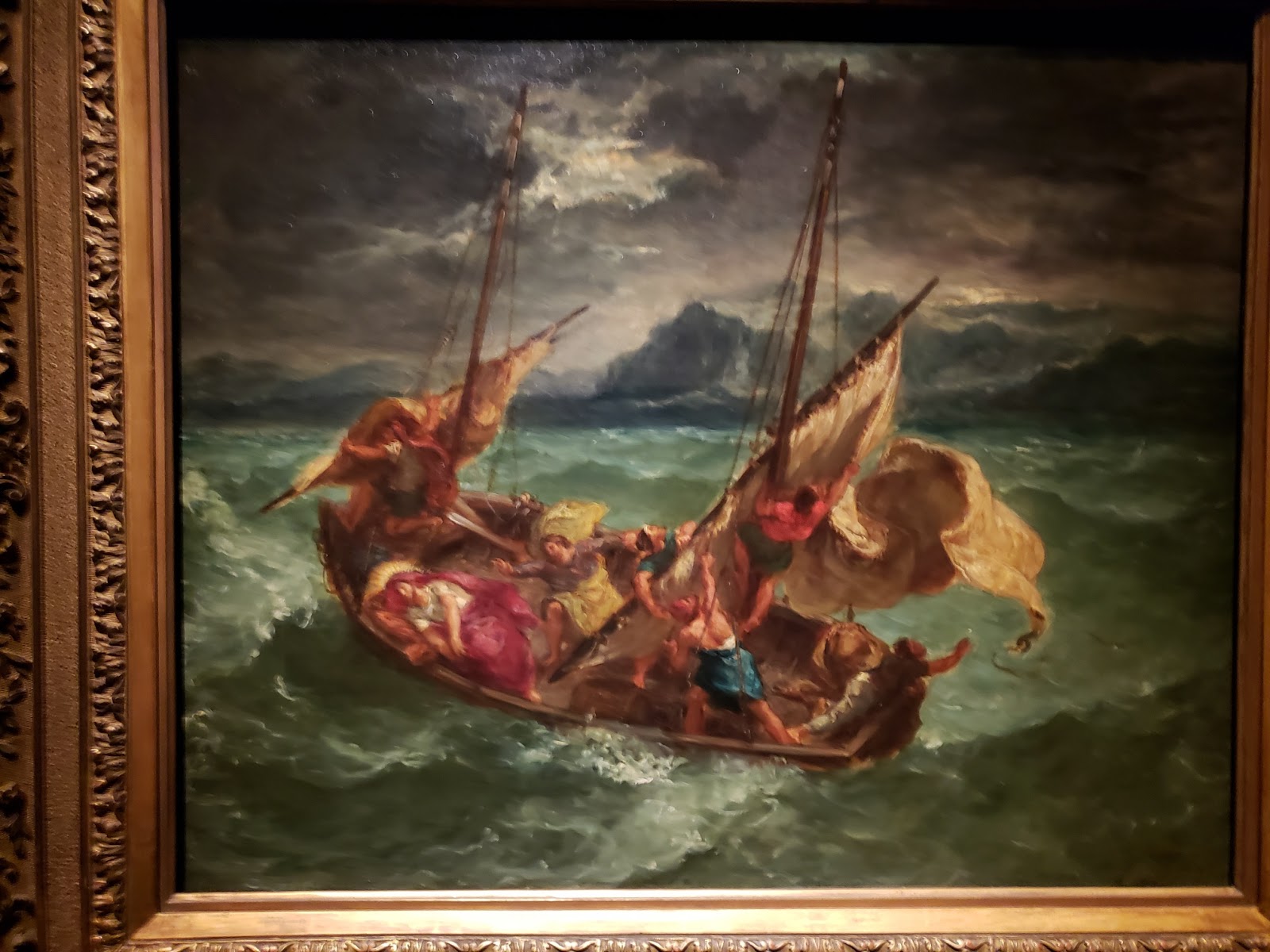


Christ on the Sea of Galilee, 1854
Delacroix painted this subject several times in 1853-54, and can be divided into two parts, those with rowboats and those with sailboats. (http://www.eugene-delacroix.com/christ-on-the-sea-of-galilee.jsp)


                                                            The Sea at Dieppe, 1852

There is much more to see, as the collection can be described as massive. There are 800 paintings, thousands of drawings, as well as manuscripts. It goes without saying but Delacroix was a prolific artist.

To truly appreciate the one in a lifetime exhibition a trip to New York is in order. But hurry, the exhibition is on view only until January 6th, 2019.

Cites


http://collections.vam.ac.uk/item/O18873/the-shipwreck-of-don-juan-oil-painting-delacroix-eugene/
http://www.eugene-delacroix.com/christ-on-the-sea-of-galilee.jsp

Monday, December 17, 2018

Good Morning Folks,
I had a very full weekend! I visited both the Yale British Museum and The Met!
While I wrap up on my paper about my experience at the Met, here are some photos and captions from my visit to the Yale British Museum.
loved the set up of this room and the collection of pieces.
"Vice Admiral Sir George Anson's Victory off Cape Finisterre" By Samuel Scott 1749 Oil on canvas

"Portrait of a Family, Probably that of Richard Streatfeild" by William Dobson 1645 Oil on canvas

"An enslaved African" by William James Muller 1838, Oil on paper laid to panel

"Grace Rose" by Frederick Sandys, 1866 Oil on panel

forgot to look at artist name.

Portrait of Mr. Van Amburgh, As He Appeared with His Animals at the London Theatres. By Sir Edwin Henry Landseer. 1846-1847 Oil on canvas.

"Wreckers - Coast of Northumberland, with a Steam-Boat Assisting a Ship off Shore." By Joseph Mallord William Turner. 1833-1834 Oil on canvas.

"The Blacksmith's Shop" By Joseph Wright. 1771 Oil on canvas.

Saturday, December 15, 2018

Wadsworth Atheneum

And for my last trick....

I took a ride up to the Wadsworth Atheneum in in Hartford this afternoon. I had held off on this one after researching much of their policies and determining that this would probably not be an ideal trip to bring the children on as, according to their website, they seem to really frown upon strollers. So, with that being said, I chose to fly solo.

But Sean,  you might be asking, didn't you mention that you also made a trip to the Aldrich Museum? Oh, indeed I did, however I hit an unfortunate snag with attempting to write about my trip to Ridgefield. While we were there, I had taken a few gallery guides with me for further reference, as the guides labeled each individual piece in an exhibit. Unfortunately, I have lost all of the guides I brought home, so I have a bunch of photos with no titles or artist information. Regardless, I would like to still post the photos from the trip before the end of the class, because I feel as someone who does not really get contemporary or modern art, it was definitely different.

Side Entrance...if you approach from Archer Street direction.
Enough about that, we are here to talk about the Wadsworth! Prior to registering for this class, I had no idea that Hartford housed a museum of this size near the Capitol Area. I wound up parking closer to the side entrance, so I never saw the building from the front entrance's exterior until I began to look more into the website for information on the history of the museum. The architectural composition of the site mirrors Yale Art Gallery in that there are multiple styles at work. Daniel Wadsworth founded the museum in 1842. The Atheneum houses not only a large collection of fine arts paintings, but a large collection of sculptures, decorative plates, vases, and even houses a gorgeous replica room from a Victorian mansion once located in Hartford.

The building itself, according to the website is actually five buildings, each with separate styles: "The first was the Gothic Revival Wadsworth building of 1844, designed by the eminent architects Ithiel Town and Alexander Jackson Davis....The Tudor Revival Colt Memorial of 1910 and the Renaissance...The Avery Memorial opened in 1934 and was the first American museum building with a modern International Style interior... the Goodwin building, designed in a late modernist style." (https://thewadsworth.org/about/history/) When the last building opened in 1969, the entire museum was a fine arts institution.

After marveling at the courtyard in the side entrance, which was lightly decorated for Christmas, I began to explore the first floor, which housed primarily contemporary art. I normally make it a habit to go at museum opening in order to avoid any potential voluminous crowds, due to weekend visiting. I found the Wadsworth to be incredibly quiet, even for 10am. It might have been because I came in the side entrance and not the front, but it was quite awhile before I encountered anyone else in the museum aside from the guards.

The courtyard displayed some interesting exampled of modern art. There was no real "theme" to the exhibit; it appeared to be more of a sampling of some more well-known artists. Again, I'm not one for contemporary and modern art. I am admittedly biased towards it, and most of the time when I visited museums during the course, I gravitated more towards the more "historic" pieces. I don't deal well with the subjective nature of the art some times. This time I decided to step out of the box a bit and spend more time looking at the contemporary art on the first floor. One of the first paintings I saw was a Piet Mondrian, Composition in Blue and White. Mondrian (1872-1944) is very well known for his unique style of abstract art, using primary colors and thick lines. A description of his work on ArtStory.com tells us, "The simplification of the pictorial elements was essential for Mondrian's creation of a new abstract art, distinct from Cubism..." (https://www.theartstory.org/artist-mondrian-piet-artworks.htm) For reference, cubism basically takes a subject, breaks the image apart and reconstructs it in an abstract form.


What stood out to me with this piece was the inclusion of just the sole colored block. Normally, the Mondrian art that I have seen in books consists of a few colors and varying sized blocks. It's sort of an unbalanced piece to me and as somebody with symmetry OCD, it throws off my sense of wanting a balanced resolution. Even in the example piece that Art Story offers, Composition with Large Red Plane, Yellow, Black, Gray and Blue, it may not be symmetrical either, but the inclusion of more color takes my focus away from that fact.


There was this one piece I stopped and looked at for a bit, mostly because, as I stated in a previous writing,  how I enjoyed urban exploration photography. I looked at it and absentmindedly photographed the placard with the artist information, not really looking at it as I did because I decided to seek out the source of the clearly audible seagull sounds I was hearing (it turned out to be a video loop installation that I didn't stop to view). I came home, grabbed a beer, and sat at the table to show my wife the photos I had taken. When I scrolled through to this one and looked at the placard, I almost choked because I can't believe I hadn't noticed it while viewing it, given the level of fame of the artist.

Andy Warhol's Triple Silver Disaster is a screen print on canvas. It's the same image three times of an empty electric chair chamber. Warhol was well-known for his silkscreen prints (the infamous Campbell Soup images are of this variety) and his pop art counterculture. It was an interesting choice for art. The information next to the images says that Warhol had released the piece around the time that New York State carried out it's final execution. Warhol made it a point to keep the Silence sign visible, I guess as a commentary on possibly either the silencing of the system or what the execution produced. I felt the off-center nature of the images was puzzling, perhaps the remainder of the canvas being blank was an expression of the silencing of the prisoner that followed?

Stack. Kenneth Noland.
Elsewhere on the first floor is a Post-World War II abstract section. Much of this to me was reminiscent of when you watch a television show and they tend to mock people analyzing like, a gigantic white canvas with a teeny red dot. I mean, there was this one work that was literally a black canvas, just a huge canvas painted black. All joking aside, I truly did enjoy looking in this wing of the museum, even at the black canvas (which I looked at for awhile and determined there were red and brown hues underlying.)

One of the more stand out-ish pieces that I stopped to check out was by an artist named Kenneth Noland. Noland was known as a color field painter. Color Field was an expressionist movement where you will find in many of the works, quite literally, large fields of color across the canvas. Noland's contribution to the gallery, Stack, painted in 1963, doesn't seem to fit that model of large amount of color usage. It was more of a geometric piece to me. I found it interesting that the canvas was rotated, because if you square it off at 90 degree angles, I feel it changes the panting entirely. With this piece, it wasn't so much the painting itself that drew me in for a closer look; I had a much more silly reason. My eye was drawn to the top of the painting and I wondered who on earth would damage a painting so haphazardly?

The information on the right of the painting tells us that Noland himself actually intentionally blotched the blue paint on the canvas in an effort to keep the work from being too rigid in composition. Once I had noticed it, admittedly, it was all I had noticed about the painting because it was this one spot of imperfection.

Down the middle of the first floor is an impressive gallery that rivals the upper floor of Yale British. The entire museum had been decorated for the holidays, so it added to the already regal and stately charm of the interior. The first photo was taken prior to entrance into the gallery and the second photo was taken in the gallery itself.


In my usual search for your standard religious Renaissance pieces, I found an interesting representation of Christ. Ecce Homo, by Luis de Morales is an example of his religious pieces he had become famous for. Morales (1509-1586) El Divino, due to his passion in painting these great religious works. Encyclopedia Britannia describes his work, "Morales always worked on panels, often depicting subjects related to the Passion of Christ, such as Ecce Homo and Pietà (1560–70), and the Virgin and Child. Perhaps the best known of these panels are 20 on the Life of Christ, painted for the Church of Arroyo del Puerco (1563–68). All of his paintings are marked by detailed execution and anguished asceticism." (https://www.britannica.com/biography/Luis-de-Morales)

Ecce Homo (Behold, Man) is an utterance by Pontius Pilate, who, according to story, had Christ beaten, flogged, and then presented to the angry Jewish mob. I think what struck me as interesting with this painting was we so often see paintings of Christ during or after crucifixion, so there is always this sense of anguish on his face, or he's already dead or resurrected. Here, we have Christ, having been shamed, beaten, mocked, looking directly at the viewer, why? I think we take into consideration de Morales' passion for his faith, and in his day this painting may have been a means to call the believer to a deeper acknowledgement of their faith or to stir up basic faith in the viewer.

When I made my way up to the second floor of the museum, I found another fascinating example of religious art. We're all familiar with daVinci's Last Supper painting. Big, long table, Jesus in the middle, sleepy, full disciples to his left and right. There's a small painting on display that changes the way to look at the scene. This Last Supper is painted by Giovanni Domenico Tiepolo sometime in the 1750s. Tiepolo (1727-1804) was an Italian painter, who was more well-known for his genre paintings. Genre paintings are pretty much paintings of normal, everyday scenes. I saw a lot of examples of American genre paintings at the museum in New Britain. So we have this rendition of The Last Supper, and Tiepolo does something incredible (to me, at least) with the scene:


He takes the table and instead of the view being almost panoramic, it becomes more of an issue of a constrained perspective (well...he also gave Jesus a shave, but that's more of a matter of artistic liberty to me).

I love what Tiepolo did with the familiar scene; it is almost as if daVinci's painting were a sculpture or a model, and Tiepolo, instead of photographing it from the front like everyone does, swung around the side of the table and captured the scene in his own way.


As much as I loved this rendition of the last supper, my favorite painting was found in a different part of the art on the second floor.


On the Yacht, "Namouna", Venice is a painting by Julius LeBlanc Stewart. What I was able to find out about Stewart while I was at the museum was that he was the son of a wealthy sugar millionaire who moved to Paris. His affluence pretty much allowed him to spend his free time painting. This painting on display is from a series involving his time sailing with a group of other rich people.
What gets me with this painting is how easy it is to immerse yourself in the scene. The angled perspective meant to mimic the rocking of the boat, coupled with the close-quarters proximity to the subjects makes you feel like you're part of the conversation; almost as if any moment the woman on the left is going to turn to you and ask if you remember some long-past event you both shared. 

The remaining portion of the second floor I wandered through had some phenomenal examples of landscape painting. This one last painting that I took a photo of before I made my way to the surrealist special exhibit (which was not able to be photographed), I thought the frame itself contributed to the viewing experience.

Vale of St. Thomas, Jamaica by Frederic Erwin Church was painted in 1867, after the artist and his wife, having lost both children to diphtheria, retreated to Jamaica for several months.


Now this to me is a landscape! Church's representation of this paradise is gorgeous, to say the least, and not even the threat of an impending storm from the west could spoil my day if this were my window on the world. Speaking of windows, when I mentioned above that the frame contributed to the experience, I had meant it in this manner. Looking at the painting, the framed image made me think of vacationing up high on some tropical mountain overlooking this valley, the frame the window on which you look out towards nature. I'm more of a forest-dwelling individual when it comes to nature retreats, but something like this would definitely change my mind!

I enjoyed my time wandering the Wadsworth today. Aside from traditional art, there's quite a bit to see in terms of vases, sculptures, and even antique silverware on display. It was a shame that the Surrealism exhibit was not able to be photographed. I found another example of a work depicting the temptation of Saint Anthony. that I would have loved to shared, given all the other ones I have seen over the course of the semester. There was a few choice Max Ernst pieces and Dali's Apparition of Face and Fruit Dish on a Beach was available for viewing (which is impressive up close).


Cited
Britannica, T. E. (2018, May 05). Luis de Morales. Retrieved from https://www.britannica.com/biography/Luis-de-Morales
History. (n.d.). Retrieved from https://thewadsworth.org/about/history/
Piet Mondrian Most Important Art | TheArtStory. (n.d.). Retrieved from https://www.theartstory.org/artist-mondrian-piet-artworks.htm


Saturday, December 8, 2018

New Britain Museum of American Art

Today I pulled another audible and went to the New Britain Museum of American Art. I replaced the Florence Griswold Museum on my schedule (side note, I checked their website and they seem to not allow photography in the galleries, so I feel a trip there would defeat the purpose). I visited the Aldrich Museum of Contemporary Art last Saturday, and I planned on writing up my visit there tonight instead, but, man, I need to reprocess my thoughts on some of that contemporary art. But anyways..

Stock photo of museum exterior because I forgot to take one
due to child-related emergency on the way out.
The four of us went to the New Britain Museum of American Art this morning, and I have to say out of every museum trip that the four of us have been on, this museum was the most accommodating for the purpose of the class and having toddlers in tow. I think this may have been my favorite museum trip so far; there is a wealth of local art on display! It was a bit colder today, and my daughter does not like to leave her shoes on. We actually only saw the first floor (which is large, to say the least) and the contemporary exhibit on the second floor because we lost one of her shoes somewhere in the galleries and they both had mini meltdowns. So, we decided after almost 100 photos, it was okay to move past the Dennis Hopper photo exhibit (Sorry, Dennis, still a big fan of Speed though!).

The New Britain Museum of American art was founded in 1903. The museum is actually the first museum of strictly American art in the country. Much of the work in display is surprisingly homegrown; I was amazed at the fact that much of the exhibits were produced by Connecticut-based artists! John Butler Talcott, an industrialist and one of the founders of the museum (we will see a portrait further into the paper) donated a gift of $20,000 in gold bonds to purchase (for the time) modern oil paintings. The museum's complement of art numbers 8,300, and according to the museum's site, "With particular strengths in colonial portraiture, the Hudson River School, American Impressionism, and the Ash Can School, not to mention the important mural series The Arts of Life in America by Thomas Hart Benton, the museum relies heavily on its permanent collection for exhibitions and programming, yet also displays a significant number of borrowed shows and work by emerging artists." (http://www.nbmaa.org/museum-of-american-art/about) I have to say, as a fan of regional landscape, their collection from the Hudson River School is amazing! Thomas Hart Benton's mural that the museum houses is something to behold as well.


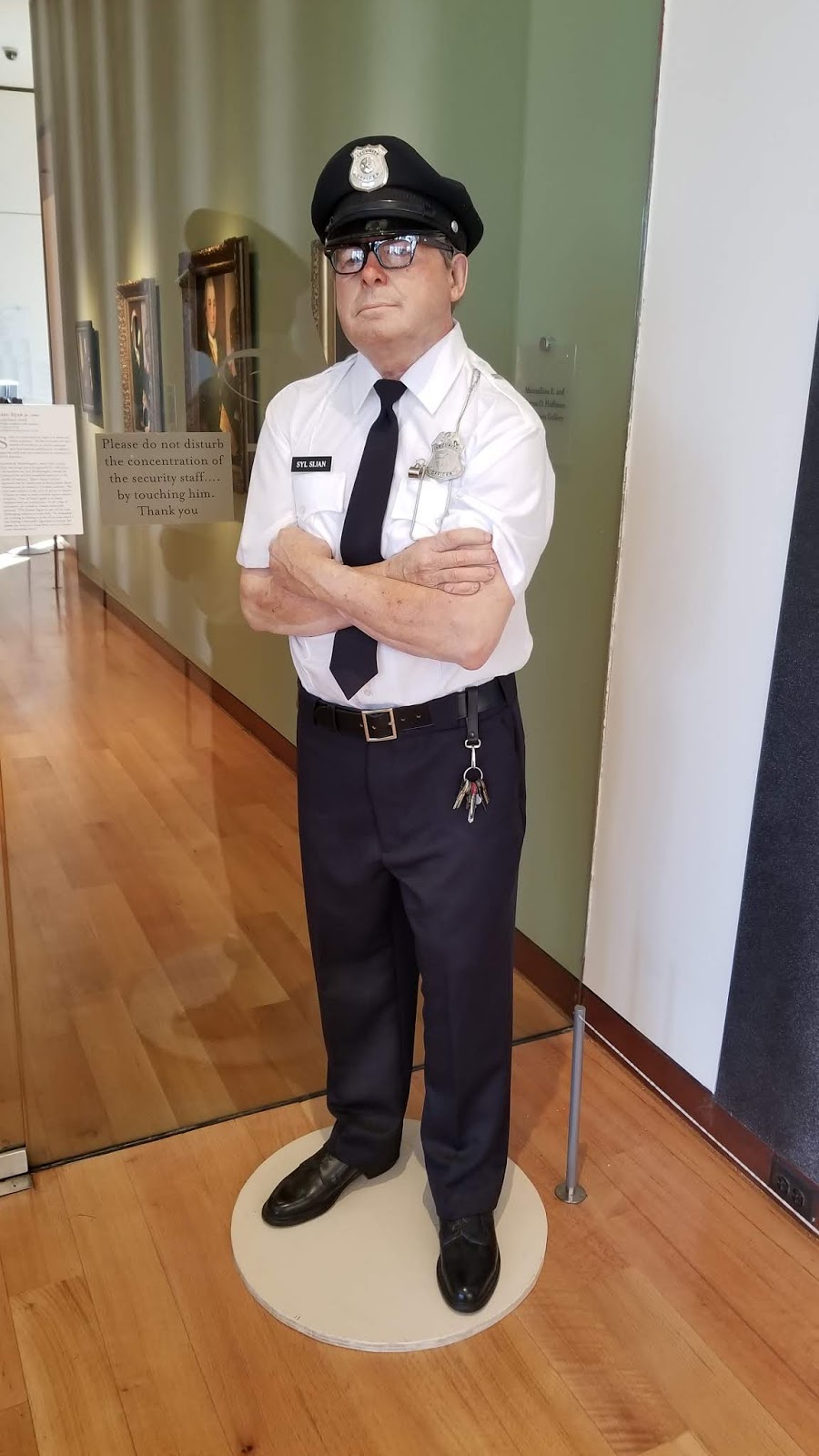
So Kiya's report on the museum showed us  the guard statue in the entrance. Because of her report, I was aware of the silent sentinel, but my wife had no idea why this guard was standing there, not holding the door for anyone. Having seen this up  close myself today. I was impressed with its life-like quality. The artist Mark Sijan created this piece in 2006 with polyresin, acrylics, acids and oil paints. His goal was hyperrealism, and I'd say mission accomplished! Looking back at the statue  as I write this, I'm still left wondering if the uniform is real clothing or it if was art of the work...


In the first gallery of portraits, I saw these two portraits side by side that were similar, yet, one was a more updated (and odd twist) on the original. The source piece is Gentleman With Negro Attendant, by Ralph Earl, 1785-1788. The painting depicts an unknown gentleman with his house boy, slave, attendant, however you'd like to classify the young boy. The placard mentions that Ralph Earl had studied with Benjamin West (whom I had previously mentioned my fascination with his inclusion in the Yale British Gallery and the fact that his piece looked like wholesale theft of John Trumbull).

Directly next to the original portrait is an updated "remix" of sorts. Titus Kaphar in 2011 duplicated the work, updated the style, and did something very interesting in that he removed all inclusion of Caucasian focus in the painting and made the young boy the focal point. Kaphar's style in his art seeks to reverse recorded black history, with these individuals in many paintings. I had been drawn to this one first because of the cutouts; I thought it was some sort of cutout that, at one time, one could get their photograph taken in. The backstory and purpose to the style is far more interesting!


I stopped at this painting in the hallway into where the main galleries began, mostly because it reminded me of something Norman Rockwell would have conjured up for a Saturday Evening Post. To my surprise first, this was a cover for a Saturday Evening Post, and second, the course for the painting was my current town of Bridgeport. Fourth of July Parade, Bridgeport , 1947 was painted by Stevan Dohanos. It depicts a father and son preparing to march in a Fourth of July parade.
I liked the small-town charm that the scene depicts; there's a simplistic sense of Americana. I also enjoyed that we can infer that this was the man on the left's childhood home because of the carving on the right post of the stairs.

It is this simplicity of the image that really keeps my focus, partly because I know what Bridgeport is, and my mind cannot fathom a time where it was this sort of small-town that Dohanos evokes through his painting.


An even bigger surprise after stopping to view this painting was doing a 180 and seeing an actual Norman Rockwell hanging directly opposite. I have never seen an actual Norman Rockwell painting before! I'd always assumed he only did those charming Saturday Evening Post covers we like to buy calendars of at Christmas. Entitled Weighing In, this 1958 painting shows a scene of a race horse jockey being weighed before he can race. I was amazed at the composition of the piece. Some paintings, you have to adjust your distance for proper viewing. The way I described seeing Rockwell's piece in person was when you purchase an album from a musician or a band that you enjoy, and you go to hear them live and they tonally sound as good as they do with the studio production involved.


The gallery rooms on the first floor were pleasant to walk through. I'm a green person; greens are my favorite colors. The walls were oddly soothing to look at in addition to the paintings themselves.

I took a large amount of photos in these portions of the galleries. The first that I'd like to share that I stopped to look at is by a local artist named Frederic Edwin Church. West Rock, New Haven, 1849 should be fairly recognizable. It is a landscape of the region surrounding West Rock, where the West Rock Tunnel on the Merritt Parkway currently runs through.
 
I admittedly spent a long time lingering more so on trying to determine if the current highway and tunnel run horizontally through the scene or on a more vertical trajectory from front of the painting to the back. The painting itself hearkens to a simpler time. I think we tend to forget that these highways, routes, parkways, roads, etc. were not always in existence, and once upon a time it was all land. There's a tranquil quality to the scene. Imagine for a moment being in this scene, working fields like the subjects are; no traffic; no delays, no Starbucks off the Amity exit. Church was also known for including a trademark steeple into his paintings (because, well, his name is Church). If you can't see it, look more to the left of the painting. I thought this was my favorite example of those on display from the Hudson River School. According to the information provided in the gallery, the Hudson River School was a movement of like-minded artists who drew inspiration from the likes of Ralph Waldo Emerson and his concepts of God-given wealth in natural resources. One can infer that in this example from the vastness of the landscape.
 
 One of my other favorite examples on display was taken from the American Genre gallery, which is in the adjoining wing. This movement, unlike the previous, which focused on the natural quality of the land, focused on the qualities of the American individual in everyday life.
 
I had stopped at a scene by Nelson Augustus Moore entitled West Springfield. Moore's painting is a fairly solid example of American life at the time, and this is something that I enjoyed throughout the entire time at the museum; the pieces were like looking backward through time in a much simpler period. West Springfield shows us a snapshot of a quiet area in the titular town. Dirt roads, sparse population. I get a sense of familiarity among the people in the painting. I've always enjoyed the Agawam area outside of Springfield; I feel it still maintains that small-town charm, with it's farmhouses and sprawling acres of land, local businesses in the downtown area. This painting was a nice reminder of what the area was, with some elements still existing.
 
Just past the American Genre galleries and around the corner, we actually get a glimpse of the museum's founder, John Butler Talcott. Talcott was born in Enfield, and had risen to become a prominent businessman in the New Britain area. William Merritt Chase was commissioned to paint the portrait. I enjoyed the portrait; it was not "stuffy" like so many portraits of businessmen appear to be. Truth be told, I felt like Talcott looked a little bit like Mr. Dawes Sr. in Mary Poppins. But in all seriousness, I thought it was a great example of what a portrait should be in regard to true representation of the subject.
Hanging in the stairwell between the first and second floors is an odd, out of place (given the progression of history among one gallery to another) painting that I looked over while I waited for my entourage to make their bathroom stops. Tar Del Mar and the Flying Brains of the Pleistocene Epoch is a painting by Karl Lund.

Karl Lund is a Simsbury native. From what I gather form his self-description on his website, he does not take himself or his work seriously and just likes to paint these grand-scale pop art sci-fi pieces, often depicting gigantic robots engaged in battle. What is interesting about his work is that he includes fairly subtle pop culture references into the work. In this example, you'll see that part of the robot is an old Atari 2600:
A component on the ship is the Flux Capacitor from Back to the Future:


And lastly, off in the distance is a very Dali-eqsue representation of Captain America's shield:
 
What I've chosen to write about as the focal piece of the paper and the trip is the mural that spans the entirety of the room by Thomas Hart Benton. The whole piece is titled The Arts of Life in America. From top to bottom: Arts of the West, Arts of  the City, Arts of the South


There is another piece that I didn't photograph entitled Indian Arts, because I thought it was a standalone piece. The information included in the gallery tells us that he was part of the Regionalist movement, which focused on agrarian life as a subject. Honestly I did not infer that from this example. The information on the wall however tells us that the purpose of the mural is to show the country overcoming adversity during the Great Depression Each individual is shown to invoke a specific talent, skill, or creative impulse that will help get them by. The information also said that Jackson Pollock was his assistant, so I found that interesting. Benton traveled America for a period and many of the subjects included were from stories of his travels. While looking up information on  his other works, I found out that some of his pieces are on display in The Met, so I regret not having time to have visited much of the American art while I was there.
 
 
As I stood and looked at the scenes and individuals, I took notice of an odd balance between individuals portraying more vice-related activities on the right as opposed to seemingly more tempered and simple individuals on the left. The southern piece also focuses on the more racial landscape of the time.  There is an inescapable fact to me that the church is included, but it is far-off in the distance, almost as a forgotten aspect of these peoples lives during the Great Depression. There is also the Revivalist-looking preacher shouting at the crowds who appear to pay him little mind. My wife had expressed disinterest in his work because she didn't like his painting style. I can't say it is the style that interested me in the mural. I stopped in to look at the piece to understand what store it was telling. To me it took on the quality of one of those old southern patchwork quilts that the women would make; each piece adding to the whole. I enjoyed how even though these were different regions of the country, Benton shows that they all blend together, each person's skill or talent in some portions beneficial to others as the scene moves on.
 
 
We did make our way to the upstairs as well, where the Jenny and Hopper exhibits were houses, but photod could not be taken of the Jenny work and the kids were tapped out before we got to the Dennis Hopper photos. This last sculpture I saw in the permanent contemporary exhibit and I enjoyed how the artist was conveying a (albeit creepy) story.
 
 
The piece on display in the photo is called Umbrella Wall #2, The Vesper Project. It is part of a larger exhibit by artist Titus Kaphar. The website for the installation tells us the story a little more in-depth:
 
"While staring at a painting by artist Titus Kaphar at the Yale Art Gallery, a man named Benjamin Vesper experienced a psychotic break and attacked one of the figures in the painting. Vesper was arrested and subsequently admitted to the Connecticut Valley Hospital where his full identity and background remained a mystery. During the course of his sessions with a psychologist, Vesper began to reveal details about himself and his family’s troubled history. Vesper remained secretive about the letters and documents he wrote to Kaphar.
In 2008, Vesper wandered off the hospital grounds, and was found squatting in a 19th century house that he insisted belonged to his family. In fact, the original Vesper home had burned down in the early 1900s. It seems Mr. Vesper needed such a space to return to, in order to engage with his own memory. It was this event that inspired “The Vesper Project” installation at Friedman Benda gallery.
This exhibition includes art works inspired by the patient’s frequent correspondence with Kaphar." (https://kapharstudio.com/the-vesper-project/) Kaphar's site also tells us that the Vespers were a 19th century black family that was able to pass for white.

Creepy and kooky; mysterious and spooky.
I stopped to check this out because there was something quite unsettling about the decomposition of the room. The walls are constructed of multiple layers of old newspaper, almost as if somebody was creating a makeshift nest. The lone portrait adds mystery to the fragment of the story we get to see here. After researching the multi-room installation when I got home, I thought that viewing one portion of the piece as a standalone does not do the exhibit justice. The website contains a panorama walkthrough of the gallery and it is a sight to behold.


Overall, the general consensus was that we all enjoyed the New Britain Museum of American Art (until we realized my daughter lost a shoe in one of the galleries and had to go back and get it almost two hours later). It's a museum I'll probably keep an eye on for upcoming exhibits to return and see.


Cited

“NEW BRITAIN MUSEUM OF AMERICAN ART.” Georgia O'Keeffe, www.nbmaa.org/museum-of-american-art/about.
“The Vesper Project.” Titus Kaphar, kapharstudio.com/the-vesper-project/.